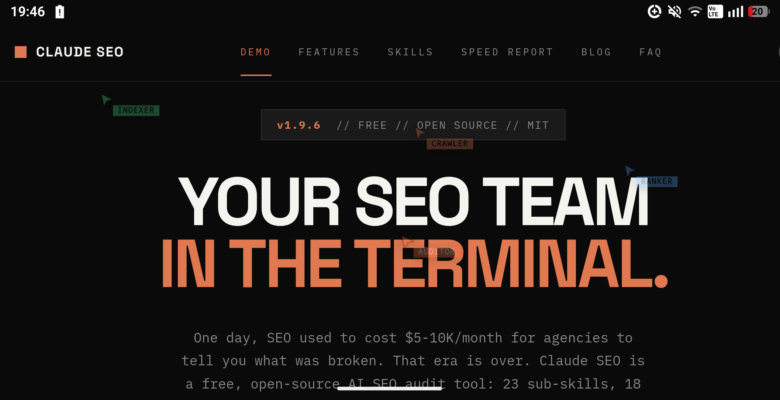
If you’ve ever paid for an SEO audit – or winced at Ahrefs or Semrush subscription fees – there’s a new player in town that costs exactly nothing. This Claude SEO Tool review covers Claude SEO, a free, open-source AI SEO audit tool built to run inside Claude Code that’s quietly becoming one of the most starred developer tools on GitHub, with 4,900+ stars and counting.
Created by Agrici Daniel, Claude SEO replaces the browser-based dashboards of traditional SEO platforms with something more powerful: a terminal-native tool that spins up 18 parallel AI agents to analyse your website and return a prioritised, 0–100 health score with actionable recommendations. The kind of report an agency would charge you $5,000–$10,000 a month to produce.
What Exactly Is Claude SEO?
At its core, Claude SEO is a collection of 23 sub-skills and 18 subagents bundled into a single install. Once you’ve cloned the repository and run the install script, you get access to over 50 commands via a simple /seo prefix inside Claude Code. The flagship command – /seo audit <url> – kicks off nine AI agents simultaneously, each tackling a different layer of your site’s SEO health in parallel.
The tool auto-detects five business types: SaaS, local service, e-commerce, publisher, and agency. It then tailors its findings and recommendations to your specific context. A local electrician’s site gets a different audit focus than a SaaS pricing page, which is exactly how professional SEO analysis should work.
Everything runs locally on your machine via Claude Code. Unless you opt into the paid extensions (more on those shortly), no data leaves your computer. For privacy-conscious developers and agencies handling client sites, that matters.
What Does the Audit Actually Cover?
The scope here is genuinely impressive. Claude SEO covers 18 distinct SEO disciplines across its full command set:
- Technical SEO – crawlability, indexability, URL structure, security headers, mobile optimisation, Core Web Vitals (including the newer INP metric), JavaScript rendering, and IndexNow support.
- E-E-A-T Content Quality – assessed against Google’s September 2025 Quality Rater Guidelines, with thin content detection built in.
- Schema Markup – detects existing Schema.org data, validates it against current Google requirements, and generates JSON-LD where needed. Critically, it knows about deprecated types like HowTo (removed September 2023) and restricted FAQPage markup.
- GEO (Generative Engine Optimisation) – this is where Claude SEO gets ahead of most paid tools. It checks your site’s visibility and citability within AI-powered search surfaces: Google AI Overviews, ChatGPT web search, Perplexity, and Bing Copilot. It audits crawler access (GPTBot, ClaudeBot, PerplexityBot), llms.txt compliance, and passage-level citability.
- Local SEO – Google Business Profile completeness, NAP consistency across citations, review sentiment, and map pack ranking factors, including multi-location setups.
- Backlink Analysis – free backlink auditing using Common Crawl, Moz, and Bing Webmaster APIs, with toxic link detection and competitor gap analysis. No paid subscription required.
- Image Optimisation – Google Images SERP analysis, WebP/AVIF format recommendations, and IPTC metadata injection.
- International SEO – full hreflang auditing with cultural profiles for DACH, French, Spanish, and Japanese markets.
- Programmatic SEO – quality gates for scaled content production.
- SEO Drift Monitoring – a SQLite-backed baseline system that acts like version control for your on-page SEO, flagging regressions over time.
Community contributors have also shipped four additional skills: semantic topic clustering via SERP overlap analysis, Search Experience Optimisation (SXO), drift monitoring, and e-commerce SEO with product schema and Google Shopping intelligence.
The 0–100 Health Score Breakdown
Every full audit produces a weighted health score. The weighting reflects where Google actually focuses its ranking signals:
- Content Quality – 23%
- Technical SEO – 22%
- On-Page SEO – 20%
- Schema – 10%
- Performance – 10%
- AI Search Readiness – 10%
- Images – 5%
Each issue is tagged with a severity level – Critical, High, Medium, or Low – so you’re never left guessing what to fix first. Critical issues block indexing or trigger penalties. High issues meaningfully impact rankings. The tiered prioritisation is one of the most practically useful features, turning a wall of findings into a sequenced action plan.
Real Audit Results from Production Sites
The project publishes actual audit results from live websites, which is a refreshing level of transparency for any SEO tool. A Nuxt 3 e-commerce site scored 64/100, with findings including multiple H1 tags, blog posts below a 1,500-word quality threshold, and missing security headers. A Next.js SaaS tool scored 58/100, partly because it was blocking GPTBot in its robots.txt – actively preventing ChatGPT from crawling and citing its content. A local electrician’s site came in at 62/100, with gaps in its Google Business Profile and missing aggregateRating schema.
These aren’t sanitised demos. They’re actual scores with actual findings, which builds confidence that the tool is producing meaningful, actionable output rather than generic recommendations.
Performance That Matches the Claims
The project also runs a speed report benchmarking Claude SEO’s own homepage against eight leading AI SEO tool homepages using Google PageSpeed Insights on mobile. Claude SEO scores 99, with MarketMuse second at 98. The next best is Semrush at 53, followed by a steep drop-off to scores in the 30s for tools like Surfer SEO and Ahrefs. Two out of eight tools pass Core Web Vitals on mobile. The median score across all eight is 44.
It’s a pointed statement: a free, open-source tool outperforming the paid platforms it’s designed to replace, on the very metrics those platforms are supposed to help you optimise.
Optional Extensions and MCP Integrations
The core tool is completely free and self-contained. For those who want to go further, Claude SEO supports three extensions. The DataForSEO extension adds 22 additional commands across live SERP data, keyword volume, backlink intelligence, and AI visibility metrics – though this requires a DataForSEO API key. The Firecrawl extension enables full-site crawling with JavaScript rendering for complex SPAs. And the Claude Banana extension adds AI image generation for SEO assets like Open Graph images and hero graphics, powered by Google Gemini.
On the MCP integration side, Claude SEO works with official Ahrefs and Semrush MCP servers, as well as community-built connectors for Google Search Console, PageSpeed Insights, and DataForSEO. If you’re already paying for one of the major platforms, this means you can pull live data from it directly into Claude SEO’s workflow.
Getting Started
Installation is three commands. You’ll need Python 3.10+ and the Claude Code CLI already installed. Then:
git clone --depth 1 https://github.com/AgriciDaniel/claude-seo.git
bash claude-seo/install.sh
Windows users can substitute powershell -ExecutionPolicy Bypass -File claude-seoinstall.ps1 for the second command. Once installed, open Claude and run /seo audit https://your-site.com. Nine agents start working in parallel. The demo video – which has racked up 31,000+ YouTube views – clocks the full process at just over 12 minutes.
Why This Matters Right Now
Two things are converging to make Claude SEO particularly timely. First, AI-powered search is no longer a future trend – Google AI Overviews, ChatGPT web search, and Perplexity are actively reshaping which content gets cited and which gets ignored. Most traditional SEO tools weren’t built to optimise for these surfaces. Claude SEO was.
Second, the cost of professional SEO tooling has always been a barrier for independent developers, small agencies, and bootstrapped startups. At $99–$117/month for Ahrefs or Semrush, many teams either go without or rely on free tools with significant gaps. Claude SEO removes that barrier entirely. MIT licensed, free forever, with no freemium tier, no paywalled features, and no data sent to external servers unless you explicitly opt in.
With 4,900+ GitHub stars and a rapidly growing community of contributors, Claude SEO is developing the kind of ecosystem momentum that keeps tools alive and improving. The recent v1.9.6 release integrated the FLOW SEO framework as a 21st sub-skill – 41 evidence-led prompts built around a structured approach to content and technical SEO – with 15 out of 15 tests passing.
If you have a terminal open and Claude Code installed, there’s no longer a good reason to pay for an SEO audit.
Find the project on GitHub, watch the full demo on YouTube, or read the documentation at claude-seo.md.